
Subbarao's annual statement will be of unusual interest this year

Short-term lending rate unchanged at 7.75 pc.

Amid expectations that the Reserve Bank may keep its monetary stance unchanged, the central bank will come out with its second quarter review of the credit policy for the current fiscal on October 27.

The bank chiefs have also cancelled the customary media conference after the bi-annual policies.

This Statement consists of two parts: Part I. Annual Statement on Monetary Policy for the Year 2007-08; and Part II. Annual Statement on Developmental and Regulatory Policies for the Year 2007-08.

While the economy will wait for a rate cut in December, the banking industry should be happy with the wave of liberalisation -- a big push for growth in bank credit, points out Tamal Bandyopadhyay.

Alliances fight wars effectively only when they share an endgame. If Israel acted without US knowledge, then the military alliance is operating without real coordination at the level of strategic targeting. Neither picture is reassuring in a war that is no longer regional in its consequences. Prem Panicker continues his must read daily blog on the Gulf War.
Reserve Bank of India Governor Yag Venugopal Reddy presents the First Quarter Review of Annual Statement on Monetary Policy for the Year 2006-07.

The Indian government has expressed its disagreement with the IMF staff's 'baseline' assumption that the 50 per cent US tariffs on its goods exports 'would remain in place indefinitely', based on which the staff pegged the country's GDP growth at 6.6 per cent this year, and pared its 2026-27 projection by 20 basis points to 6.2 per cent.

The government on Monday appointed three eminent economists Ashima Goyal, Jayanth R Varma and Shankanka Bhide as members of the rate-setting Monetary Policy Committee of the RBI

Wholesale inflation fell to a 3-month low of 2.04 per cent in July on decline in prices of food items especially vegetables, government data released on Wednesday showed. The decline in wholesale price index (WPI) based inflation in July came after it rose for four months in a row till June, when it was 3.36 per cent. It was (-) 1.23 per cent in July last year. In April wholesale inflation stood at 1.19 per cent.

Currently, non-residents visiting India are not allowed to take out any Indian currency while leaving the country.
The Reserve Bank of India said on Tuesday it would accord highest priority to contain inflation within 5 to 5.5 per cent, while keeping its projection for economic growth during 2006-07 unchanged at 7.5 to 8 per cent.

The Urjit Patel committee on monetary policy framework has proposed setting up of a monetary policy committee (MPC) that will be headed by the Reserve Bank of India (RBI) governor and accountable for achieving inflation target set by it.

The Reserve Bank of India on Thursday opted for a pause second time in a row, maintaining key benchmark policy rate at 6.5 per cent as inflation moderates. The rate increase cycle was paused in April after six consecutive rate hikes aggregating to 250 basis points since May 2022. Announcing the bi-monthly monetary policy, RBI Governor Shaktikanta Das said the Monetary Policy Committee (MPC) unanimously decided to keep the rate unchanged at 6.5 per cent.

Wholesale inflation rate declined marginally to 0.2 per cent in February compared to 0.27 per cent in the preceding month despite a slight uptick in the food basket. The Wholesale Price Index (WPI)-based inflation was in the negative zone from April to October and had turned positive in November at 0.26 per cent. The inflation in February 2023 was 3.85 per cent.

The wholesale price index (WPI)-based inflation eased in January to 0.27 per cent, mainly due to moderation in prices of food items. WPI inflation was at 0.73 per cent in December 2023. The WPI inflation was in the negative zone from April to October and had turned positive in November at 0.39 per cent.
In a move that may put pressure on housing and other consumer loans, Reserve Bank of India on Tuesday hiked its short term lending and borrowing rates by 0.25 per cent.
In a move that may put pressure on housing and other consumer loans, Reserve Bank of India on Tuesday hiked its short term lending and borrowing rates by 0.25 per cent.
The country's economic growth slipped to a decade-low of 4.5 per cent in 2012-13 and is estimated at 4.9 per cent in the current financial year.

India's current account deficit (CAD) may dip further in the March quarter of FY24 as pressure from the negative net exports during the January-March period eased to an 11-quarter high. A part of the gross domestic product (GDP) data, net export- which is usually negative for India - captures the difference between exports and imports of both goods and services, while the CAD data, released by the Reserve Bank of India (RBI), also factors in private transfer receipts.

'The actions of Indian monetary authorities will depend on how quickly they want the inflation to come down to 4 per cent.'

Encouraged by foreign exchange reserves touching record levels, the Reserve Bank on Tuesday doubled the annual overseas investment ceiling for individuals to $2,50,000.
The Reserve Bank of India on Wednesday retained the economic growth projection for the current financial year at 10.5 per cent, while cautioning that the recent surge in COVID-19 infections has created uncertainty over the economic growth recovery. In its last policy review, the RBI had projected a GDP growth rate of 10.5 pc for FY'22. Taking various factors into consideration, it said, "the projection of real GDP growth for 2021-22 is retained at 10.5 per cent consisting of 26.2 per cent in Q1, 8.3 per cent in Q2, 5.4 per cent in Q3 and 6.2 per cent in Q4."

He has also said that the overall mood of the Indian consumer remains subdued
Salaries of top management executives at private and foreign banks will have to be as per the Reserve Bank of India's guidelines from next fiscal, central bank said on Tuesday, while asking the lenders to start preparing for the new wage rules.

The RBI kept interest rates unchanged at 8 per cent as widely expected.

Making a case for raising prices of diesel, kerosene and LPG, the Reserve Bank on Tuesday said hike in rates of petroleum products is necessary to arrest fiscal slippages.

The task force will look at emerging markets, technology, regulatory and monetary policies, loss of trust in financial services, and financial inclusion.
The Reserve Bank of India on Friday cut short-term lending rate by 0.25 per cent.

The Reserve Bank, in Annual Monetary Policy Statement, has also asked banks to set up internal exposure limits for those non-banking financial companies who have gold loans portfolio of more than 50 per cent of the total financial assets.
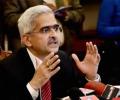
The Reserve Bank of India on Friday decided to leave benchmark interest rate unchanged at 4 per cent but maintained an accommodative stance as the economy faces heat of the second Covid wave.
.jpg)
Industry's demand for a reduction in the repo rate, currently 8 per cent, has gained momentum after wholesale and retail inflation eased in February.

Inflation in food articles during June stood at 2.04 per cent, as against 1.13 per cent in May.

Inflation in food articles during May stood at 1.13 per cent, as against 2.55 per cent in April.
The Reserve Bank of India kept interest rates unchanged at 8.0 percent on Tuesday as widely expected, staying focused on containing inflation while adopting a more dovish tone in response to the government's call for help to revive economic growth.
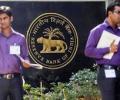
RBI is scheduled to announce mid-quarter review of monetary policy for 2013-14 on June 17.
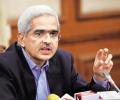
Softening inflation, Das said would make available more policy space to the central bank to address risks to the growth going forward.

After two surprising, successive rate cuts in January and February 2015, RBI governor Raghuram Rajan decided not to reduce them further in his first policy announcement in the new financial year. Is he playing spoilsport for consumers of homes and cars?
 © 2026 Rediff.com - Advertise with us - Disclaimer - Privacy Policy - Sitemap - Feedback - About us - Terms of use - Grievances